Download from
Play Store

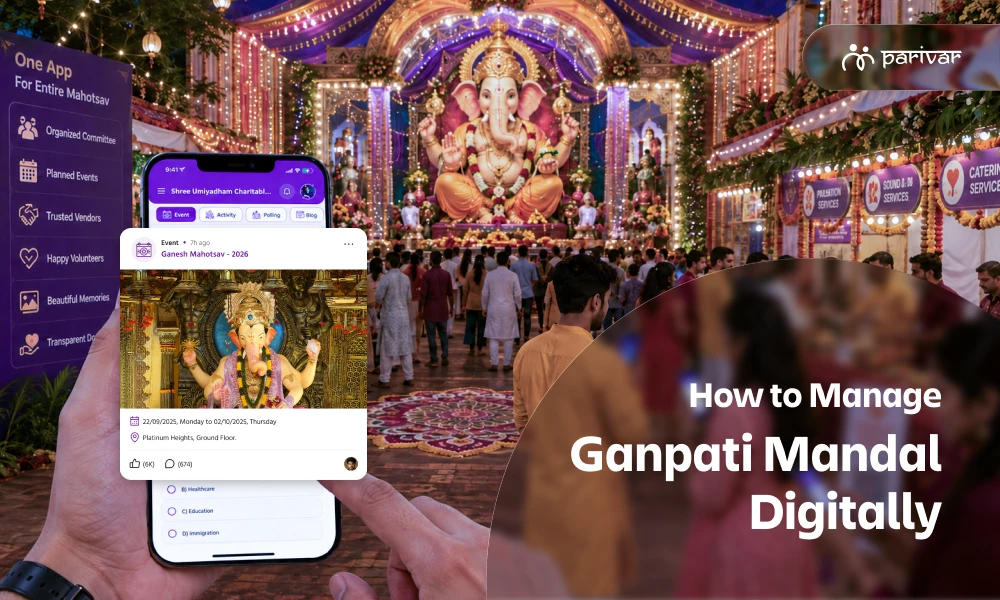
TABLE OF CONTENTS
This year, even the paperwork went digital.
The BMC has introduced an online single-window system for Sarvajanik Ganeshotsav mandals, allowing committees to apply for civic permissions and police and traffic NOCs through a single digital platform. It is a welcome change for mandals that have traditionally had to manage paperwork, visits, stamps, and signatures across multiple offices.
But there is a bigger question worth asking:
If your mandal has gone digital for permissions, why is everything else still running on WhatsApp groups, notebooks, spreadsheets, and scattered phone contacts?
Getting the NOC online is only one part of organizing Ganeshotsav. The real work begins when the committee has to coordinate volunteers, manage events, track contributions, communicate announcements, work with vendors, and keep the community involved for the entire festival.
That's where a dedicated digital community platform can make a real difference.
Anyone who has been part of a Ganpati mandal committee knows that organizing the festival involves much more than putting up a pandal.
Yet much of it still happens through tools that weren't designed for community management.
There may be one group for the core committee, another for volunteers, another for the youth team, and another for general announcements. Important messages quickly get buried under conversations, forwarded videos, and unrelated updates, a problem worth comparing against how community platforms differ from messaging groups built for actual coordination.
Chanda and other contributions may be recorded in notebooks, spreadsheets, or individual phones. As the number of contributors grows, it becomes difficult to know what's collected, what's pending, and who is responsible for following up.
Aarti timings, cultural programs, prasad distribution, competitions, and visarjan arrangements can easily disappear into chat history.
Someone inevitably ends up asking: "Aaj aarti kitne baje hai?"
A family that recently moved into the neighborhood or a volunteer who wants to participate may not know who to contact, what activities are planned, or where their help is needed, the same gap that comes up whenever a community has to onboard new members without a clear process in place.
The problem isn't that committees aren't organized.
The problem is that they're trying to run a temporary community organization using tools built primarily for messaging.
A Ganeshotsav mandal is essentially a small community organization. It has a committee, members, volunteers, activities, responsibilities, and a schedule. A useful digital setup should therefore bring these things together in one place, much like any well-run small community does.
Different people have different responsibilities.
Core committee members may handle planning and administration, while volunteers may only need access to activities and events.
A digital community platform can help organize members according to their roles, echoing the broader role committees play in building a community, making responsibilities clearer and reducing unnecessary communication.
Ganeshotsav can involve ten days of aarti, cultural programs, competitions, prasad distribution, special guests, and visarjan arrangements. Instead of repeatedly sharing the schedule in WhatsApp groups, creating and managing community events in one place gives members a single point to check what's happening and when.
Not every conversation belongs in the same group.
Decoration planning, volunteer coordination, cultural programs, general announcements, and committee discussions can be organized separately, the same way any safe, well-structured space for community discussions keeps important information easy to find.
Every year, mandals need decorators, caterers, electricians, sound providers, pandal contractors, dhol-tasha groups, photographers, and other local businesses.
Instead of relying on one committee member's phonebook, trusted vendor information can be maintained through a business directory built for community use and passed on to the next committee, a natural way to also support local businesses within the community.
Ten days of Ganeshotsav can generate thousands of photos and videos scattered across different phones and WhatsApp chats. A shared community album can bring everyone's memories together. And unlike a temporary chat, those memories can remain accessible after the festival.
Volunteer registrations, contribution pledges, event participation, feedback, and other requests are easier to manage when they're organized as structured requests rather than buried in conversations. Members can see what is needed, respond, and help the committee keep track.
This is where Parivar fits naturally into the Ganeshotsav workflow.
Parivar app is designed to give communities, committees, and groups a dedicated digital space where members can connect, organize activities, share information, and stay involved.
Instead of using several disconnected tools, your mandal can bring important community activities together.
Use the Committee feature to organize your core committee, volunteers, and members according to their responsibilities.
Use Events to create the complete Ganeshotsav schedule from daily aarti timings and cultural programs to competitions, prasad distribution, and visarjan activities.
Use Discussion Boards to separate conversations around decorations, volunteering, programs, announcements, and other activities.
Use the Business Directory to maintain details of decorators, caterers, contractors, and other trusted local businesses.
When the next Ganeshotsav arrives, the information is already there.
Use Albums to bring together photos and videos shared by members throughout the celebration.
Your Ganpati celebration doesn't have to disappear into old WhatsApp chats once the festival ends.
Use Requests to organize volunteer sign-ups, contribution pledges, feedback, and other requirements in a more structured way.
The result is simple:
Less searching. Less repeating. Less information getting lost. More people staying involved, the kind of steady participation that comes from genuinely increasing community member engagement.
The move toward online permissions is an important step. But digital transformation shouldn't stop once the NOC is approved.
The real opportunity is to digitize the community itself, part of what's shaping the digital samaj as the future of community living.
Your committee members, volunteers, vendor contacts, event schedules, discussions, and festival memories don't disappear after Ganesh Visarjan.
In fact, the festival may be over, but the community's sense of belonging continues.
Navratri comes next. Then Diwali. Other community activities follow, and rather than starting over each time, committees can simply manage multiple communities from one account. And when the next Ganeshotsav arrives, you'll once again need the same members, volunteers, vendors, and organizational knowledge.
A permission portal helps you complete a process.
A community platform helps you build continuity.
That's the bigger reason to set up your mandal digitally.
You don't need to digitize everything on day one. Start with the basics, using a community digital readiness checklist as a guide:
Once the basic structure is in place, everything else can grow around it. Because Ganeshotsav isn't just about managing permissions. It's about bringing a community together. And your mandal deserves a digital space built for exactly this kind of community.
Download Parivar on the Google Play Store and App Store and start building your mandal's digital community today.
TABLE OF CONTENTS
ABOUT

Parivar - Bringing all community members together at your fingertips, the community engagement app will let you connect with your community conveniently.
SUBSCRIBE TO OUR NEWSLETTER