Download from
Play Store
TABLE OF CONTENTS
There was a time when you could walk down the street and know every family in your samaj. Community events meant meeting everyone, celebrating together, and feeling like you truly belonged.
But things have changed.
Now, people are spread across the world, and it’s hard to feel truly connected.
What if there was a better way to bring everyone back together, no matter where they live?
That’s what a Digital Samaj is all about, a practical, modern way to bring communities together in the digital age.
A Digital Samaj is a modern way to bring traditional communities like family groups, caste samajs, housing societies, alumni circles, or religious groups together in one secure online space.
It replaces the chaos of scattered apps and group chats with a dedicated space for everything your community needs: member directories, events, announcements, photo sharing, matrimony, and more.
It’s a simple way to:
Most communities rely on general-purpose apps, or email to stay in touch. But these tools weren’t built for community management.
Here’s what often goes wrong:
A Digital Samaj, on the other hand, is made specifically for these needs. It brings order, clarity, and peace of mind.
A Digital Samaj isn't just about moving your community online, it's about making it more connected, organized, and meaningful for everyone involved. For it to truly work, a few key things need to come together:
Unlike noisy group chats or public social media, a digital samaj gives your members a clean, focused environment where updates don’t get buried under forwards or ads. Everyone knows where to find what they need.
Having an updated directory of families, individuals, contact details, and roles helps everyone stay informed. Whether it’s finding a family’s address, a youth member’s number, or senior citizens in the group, you can get it all in one place.
From religious programs to community meetups, a good digital samaj includes an event calendar and planning tools so members never miss important gatherings, and organizers don’t have to send 10 follow-ups.
In large families or traditional samajs, understanding who’s related to whom can get confusing. A visual family tree or relationship map helps connect generations and preserves family history.
Whether it’s photos from a recent gathering, a wedding, or a sammelan, having a central place to upload and revisit memories adds emotional value, and keeps the community feeling alive.
Different groups within the samaj (youth wing, women’s group, committee) may need their own space. With role-based access, admins can organize and manage the community more smoothly without confusion or overlap.
If an app is too complicated, people won’t use it. A successful digital samaj platform is designed for everyone from tech-savvy youth to elders with simple navigation, clear buttons, and local language support.
Privacy matters, especially for sharing personal details like contact numbers, photos, or matrimonial info. A good digital samaj ensures data security and only allows trusted members inside.
The concept of a digital samaj may sound new, but it’s already in action, with apps like Parivar.
What started as a family app is now used by samajs, housing societies, and religious groups to stay better connected.
As life gets busier and families live farther apart, communities need a smarter way to stay connected, and rooted.
A Digital Samaj helps:
Just like we moved from physical albums to cloud storage, it’s time to move from scattered groups to a digital home for your samaj.
If you’re part of a samaj, large family, or a small community group that wants better connection without the mess of multiple apps, now’s the time to go digital, with intention.
Parivar App helps you build your Digital Samaj, securely, privately, and beautifully.
Download the Parivar App and start building your community space today.
📱 Available now on Google Play Store and App Store.
TABLE OF CONTENTS
ABOUT

Parivar - Bringing all community members together at your fingertips, the community engagement app will let you connect with your community conveniently.
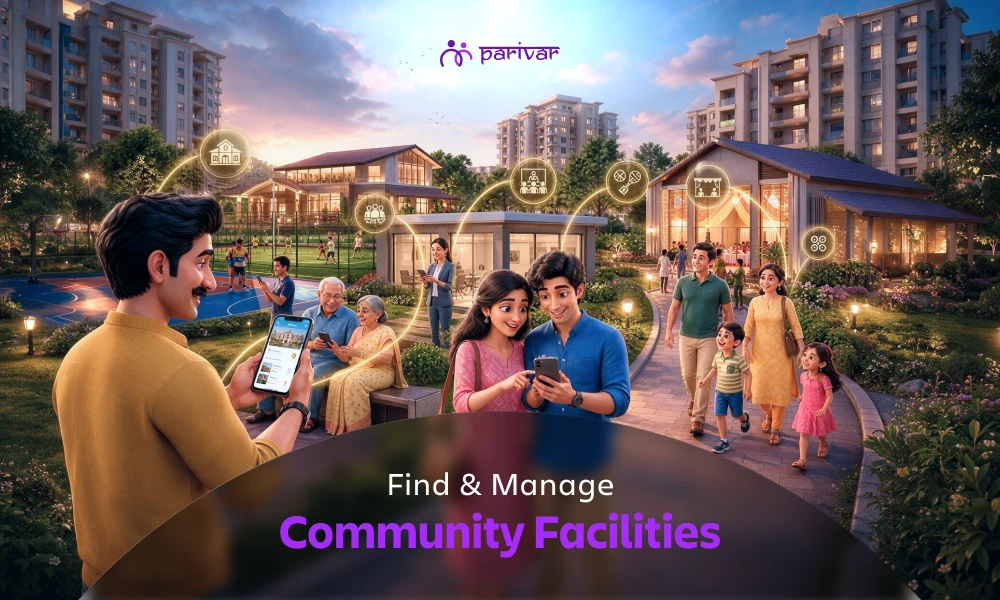
Managing community facilities whether it’s a meeting hall or an event venue might seem straightforward. But anyone who’s been part of a facility management committee knows the truth: it can get messy fast. Double bookings, missing approvals, and endless chat threads often turn a simple task into a headache. The good news? Most of these problems aren’t new and they can be easily solved. Let’s look at five common mistakes communities make when managing shared spaces, and how the Facility feature in Parivar helps fix them once and for all. Common Mistakes in Community Facility Management Even well-organised communities face challenges when it comes to managing shared amenities. From unclear booking processes to poor communication, these small mistakes can create unnecessary confusion and conflict. Here are the most common ones and how Parivar App helps solve them. Mistake #1: Relying on Manual or Word-of-Mouth Bookings In many communities, booking a space still happens through calls, chats, or a scribbled note on a noticeboard. It works… until it doesn’t. One member books the hall for an evening function, another assumes it’s free, and suddenly you have two parties and one venue. How the Facility feature helps: With Parivar, all facilities are listed digitally with real-time availability. Members can view open slots, contact the respected person, book instantly, and get confirmations. No middlemen, no confusion. This prevents overlaps or miscommunication. Mistake #2: Lack of Clear Information About Facilities Sometimes members don’t even know what facilities are available or how to use them. Maybe the yoga studio exists but isn’t clearly listed anywhere. Or the conference room has certain rules nobody remembers. How the Facility feature helps: Each facility on Parivar has a dedicated listing: images, capacity, location, and usage guidelines. Members can review everything in one place before booking. This ensures better visibility and usage of all community spaces, not just the popular ones. Mistake #3: Poor Communication Between Members and Admins Without a structured system, booking requests often get buried in chat groups or delayed in approval cycles. The result? Frustrated members and overwhelmed admins managing reminders and follow-ups. How the Facility feature helps: Parivar streamlines communication. Members can contact the respected person directly through the app and request bookings. Mistake #4: No Transparency in the Booking Process One of the biggest sources of friction in community living is perceived unfairness. When bookings happen informally, it’s easy for people to think that certain members get priority access, even when they don’t. How the Facility feature helps: Parivar promotes complete transparency. Everyone can view the facility and understand how approvals work. The entire process is open and visible, removing doubts, bias, or hidden queues. A Hassle-Free Facility Management Process When these mistakes are avoided, life gets easier for everyone. Admins save hours each week, members know exactly how to book, and the entire community functions with more trust and clarity. With Parivar’s Facility feature, communities gain: Convenience: Book anytime, from anywhere. Transparency: All the details are mentioned without any biasness. Efficiency: Members can easily check for their requirements without stress and save time. Take, for instance, a housing society with multiple amenities: a hall, gym, and swimming pool. After adopting Parivar, they reduced booking-related complaints by half and improved overall facility utilisation because members finally had full visibility into what was available. Building Trust Through Better Systems Facility management isn’t just about reserving spaces, it’s about ensuring fairness, communication, and harmony in shared living. With Parivar’s Facility feature, communities can bring structure to what was once chaos, creating an easier, more transparent way to manage shared spaces that everyone can trust. Want to simplify your community’s facility management? Download the Parivar App today on Google Play or App Store and experience seamless, transparent facility booking for your community.
Remember the last time your whole family was in the same room, but each person was absorbed in their own screen? One might be scrolling through social media, another watching a video, and a third playing a game. This scene is common in homes today. Technology offers real value, helping us with work, education, and keeping in touch with those who live far away. The difficulty arises when screens begin to occupy the space meant for conversation, shared laughter, and simply being present with one another. This is not about declaring technology the enemy. It is about making a conscious effort to enjoy its benefits while still protecting the irreplaceable warmth of family and community life. Finding a balance between screens and real-life interactions can help families grow closer and strengthen community bonds. The Value of Being Truly Present Why is balancing screen time with face-to-face interaction so important? The reasons are rooted in our fundamental human needs. The need for connection is met through face-to-face interaction in a way that digital communication cannot replicate. For children, regular, screen-free interaction is how they learn to read facial expressions, understand tone of voice, and develop empathy. These are skills built through practice, not through a screen. For adults and seniors, consistent in-person contact is a powerful remedy for feelings of loneliness and isolation. It provides a sense of being seen and valued. For the entire family or community, these shared moments create a strong foundation of trust and belonging. They build a shared history of inside jokes, stories, and experiences that form your unique identity. When screens take priority, we miss the small, meaningful interactions that strengthen our bonds. This can lead to children engaging less with siblings, parents overlooking precious moments, and shared activities like meals losing their significance. Too much screen time often leaves us feeling drained, less focused, and disconnected from those right beside us. This is precisely why face-to-face interaction is irreplaceable. It is the essential practice for building trust and empathy. Undistracted time together whether cooking, walking, or talking teaches effective communication, problem-solving, and emotional support. These interactions are the foundation for emotional growth and a lasting sense of belonging, especially for children. Practical Ways to Balance Screen Time Achieving balance does not require drastic measures. It is about introducing small, consistent habits that encourage connection. 1. Create Tech-Free Spaces Choose specific areas or times in your home where screens are not allowed. The dinner table is an excellent place to start. Bedrooms, especially for children, can also be designated as device-free to promote better sleep. Similarly, set aside certain times of the day, such as during meals or the first hour after everyone comes home, to be fully present with each other. 2. Share Screen Experiences Not all screen time has to be isolating. The key is to make it a collective experience. Watch a movie or a documentary together and talk about it afterward. Play a multiplayer game as a family or learn something new online together. When you video call relatives, do it on a shared device in the living room so everyone can join the conversation, transforming a one-on-one call into a family event. 3. Lead by Example Children learn more from what we do than what we say. Make a conscious effort to put your phone away when a family member is speaking to you. Talk openly with your children about your own attempts to manage screen time. When it becomes a shared family goal instead of a rule imposed only on the young, everyone is more likely to participate willingly. 4. Use Technology Thoughtfully Use reminders, screen-time trackers, or apps that encourage healthy device use. The goal is not to avoid screens completely, but to make sure they don’t interfere with family life. 5. Plan for Connection In our busy lives, meaningful time together often will not happen unless we plan for it. Schedule it. A weekly family walk, a Saturday morning breakfast where everyone helps cook, or a monthly board game night can become anchors that everyone looks forward to. For your wider community, this could be a regular potluck dinner or a book club. Using Parivar to Support Your Goals You might wonder how an app can help reduce screen time. The purpose of Parivar is different from platforms designed for endless browsing. Parivar app is built with a single goal: to make real-world connection easier for families and communities. Parivar acts as a central place for your community to coordinate, share, and strengthen the networks of support that are essential for a fulfilling life. It is designed to facilitate the very in-person connections we are striving to protect. The Parivar app is available for download on both iOS or Android, making it easy for everyone in your family and community to get started. The Reward of Small Changes for Family Finding a healthy balance with technology is a continuous process, not a finish line you cross. There will be days that are better than others. The objective is not perfection, but awareness and gradual improvement. Begin with one small change. These small steps, repeated consistently, build a culture of connection within your home. The most meaningful parts of our lives happen in the time we spend fully present with one another. Let us use technology as a tool to support those moments, not to distract us from them. What is one change your family will try this week? Share your plan in your Parivar family group to inspire others.
Imagine sending your child off to school and wondering if they reached safely, or picking up an elder from a crowded market and worrying if they are on the right bus. These small moments of worry are part of everyday life but they don’t have to be. With the Parivar app, families can stay connected and informed in a way that feels natural, safe, and reassuring. How Parivar’s Family Member Location Sharing Works Parivar’s Family Member Location Sharing is designed to be simple, secure, and respectful of privacy: Invite and Join: Only family members you invite can join your private circle. Permission-Based Sharing: Each member decides if they want to share their location. Real-Time Updates: Once permission is given, the app updates their location every 10 seconds. Private and Secure: Location data stays within your family circle, no one else can see it. Parivar app ensures families stay connected without feeling watched. Download the App Download the app today on iOS or Android and start sharing locations safely and easily with your family. Why Location Sharing Helps Your Family 1. Know Your Loved Ones Are Safe The biggest benefit of location sharing is peace of mind. Parents can see if kids have reached school or activities safely, and adult family members can check in during emergencies. Real-time updates make it easy to respond quickly when needed. 2. Build Trust, Lessen Worry Location sharing isn’t about tracking every move, it’s about being there when it matters. Families can respect each other’s space while knowing everyone is safe, reducing unnecessary worry and fostering trust naturally. 3. Help When It Matters Most Life is unpredictable. If someone gets lost, delayed, or needs help, real-time location sharing allows family members to act immediately. It’s a small tool that can make a big difference in urgent situations. 4. Simpler Coordination Location sharing makes planning easier. Everyone can see where others are, reducing the need for constant calls or messages and helping the day run more smoothly. Keep Your Family Close, Even When Apart Families don’t need to worry constantly, they just need a way to stay connected safely. With Parivar app, location sharing becomes a helpful, natural part of family life. Everyone knows where their loved ones are, and everyone feels a little safer and more connected without compromising privacy.