Download from
Play Store
TABLE OF CONTENTS
Family traditions have always been about togetherness: celebrating festivals, milestones, and memories that bring everyone closer. But in today’s fast-paced world, staying connected isn’t always easy. With family members living in different cities or even countries, many families are finding new ways to keep their bonds strong.
That’s where digital platforms like the Parivar App are quietly changing how families celebrate, share, and stay close.
Traditions once lived around the dining table or at festive gatherings. Now, they’ve found a new space: our phones.
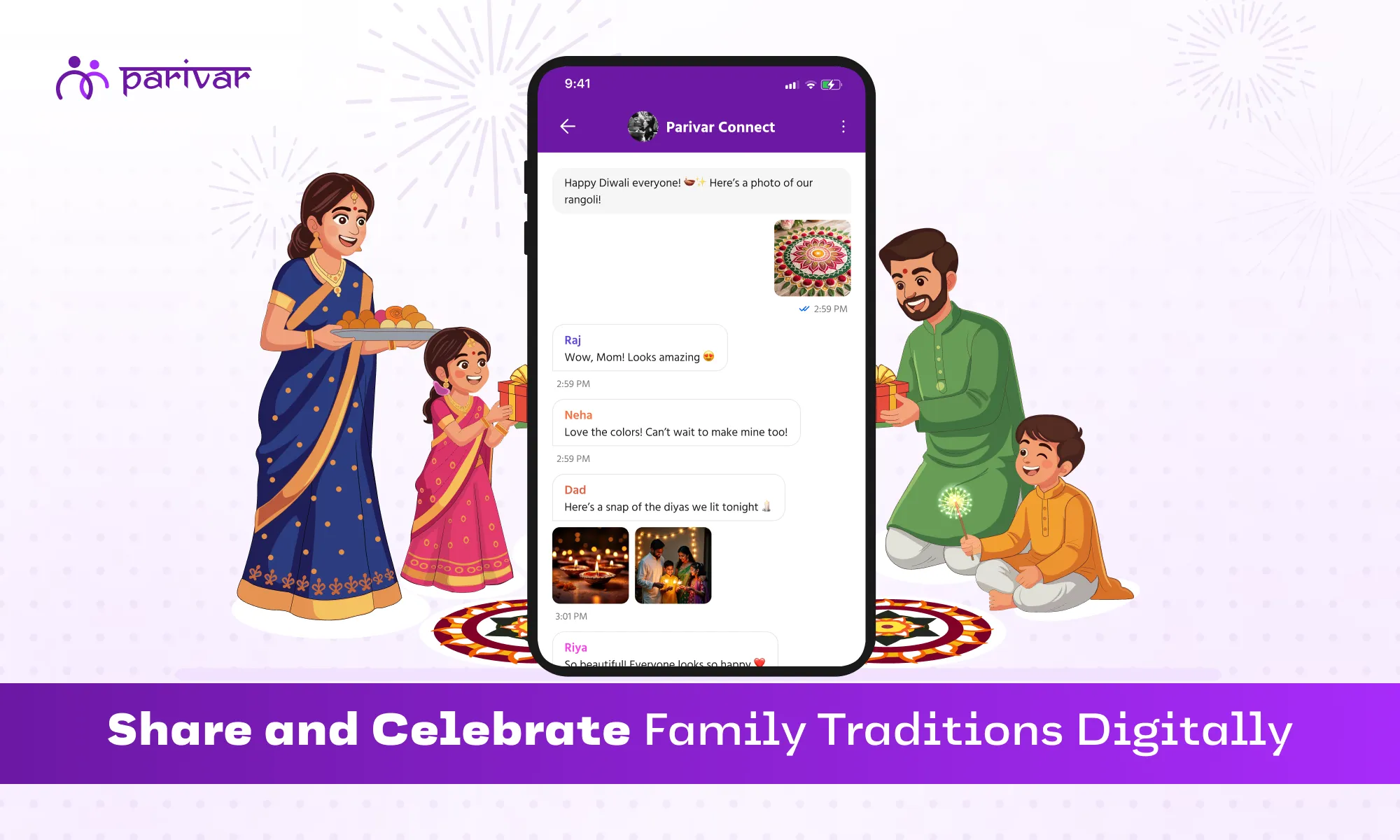
Families are using online platforms to recreate those familiar moments. Whether it’s sharing photos from a Diwali puja, posting birthday wishes, or announcing a new family achievement, the digital world is helping preserve what really matters: ‘connection’.
With Parivar, families can build a private space where every memory, ritual, and celebration stays within the family circle. There’s no noise or distractions, just your people, your stories, your moments.
Every family has its own little traditions like lighting the first diya together, Sunday lunches, or remembering elders on special days. Now, these moments don’t have to stop because of distance.
With Parivar:
The joy of celebration stays the same, only the medium changes.
You can easily download the Parivar App on Android and iOS to start bringing your family together in one shared space wherever they are.
In many families, stories and rituals are passed down through words. But with technology, we can now record, store, and share these traditions forever.
These digital memories become a treasure chest of your family’s story which is safe, private, and always accessible.
Parivar is an app that acts like a bridge between generations helping strengthen family bonds.
By bringing everyone onto a single, secure platform, Parivar turns digital interaction into real emotional connection.
Through apps like Parivar, families are building new traditions:
Or just posting a memory that makes everyone smile.
The essence of family stays the same: love, care, and togetherness. Only now, it travels through the digital world.
As life gets busier, technology is giving families a way to keep traditions alive and relationships warm.
The Parivar app helps every family stay connected, celebrate milestones, and pass on memories with one shared moment at a time.
Because in the end, family isn’t just who you’re born with, it’s who you stay connected with.
TABLE OF CONTENTS
ABOUT

Parivar - Bringing all community members together at your fingertips, the community engagement app will let you connect with your community conveniently.
SUBSCRIBE TO OUR NEWSLETTER

You moved abroad for work, studies, or a better opportunity. The plan was always to stay close to family back home. And for a while, the weekly video call worked. But slowly, things start slipping. You miss a cousin's engagement announcement buried in the family WhatsApp group. Your mother doesn't know how to share the photos from the pooja she did last week. Your kids are growing up without really knowing who their relatives are. The distance isn't just physical. It quietly becomes emotional too. Most NRI families go through this. And a video call, as good as it is, can only do so much. Why NRI Families Struggle to Stay Connected Over Time Most families living abroad rely on a mix of WhatsApp groups, occasional calls, and social media to stay in touch. It works for urgent updates. But it doesn’t work well for everything else. Common Problems Families Face A few problems that come up regularly: Important updates get lost: In a busy family group, a cousin sharing their exam results or an elder posting a family photo disappears within hours under forwards, jokes, and good morning messages. There's no shared family space: Photos from a function back home land in one group. A relative's job update comes through another. There's no single place where the family story lives together. Kids born abroad feel like outsiders: They know the names, but they don't know the relationships. They've never seen the family tree. They don't know which uncle is on which side or how the extended family connects. Elders get left behind: Parents and grandparents in India often don't know how to share things in a way that reaches everyone. They send one message at a time, to whoever they remember. It's important to stay connected with elders digitally. None of this happens because people stop caring. It happens because the tools being used were never designed for families. What NRI Families Actually Need to Stay Connected Staying connected as an NRI family is about more than messaging. It requires a space where: Family memories are stored in one place, so you can revisit them anytime Birthdays and important dates aren’t missed The family tree is visible and updated, so younger members know where they belong Events back home can be shared with everyone, including those abroad Relatives in India can participate easily, without needing to be tech-savvy When everything lives in one place, staying connected stops feeling like effort. It becomes something people naturally stay part of. A Better Way for NRI Families to Stay Connected Parivar was built for families like this, not just nuclear families in one city, but large Indian families spread across countries. Unlike WhatsApp or social media, Parivar is designed specifically for families, not general communication. Let’s find out why Parivar works better than social media apps for this purpose. 1. Moments That Don't Get Lost Photos from weddings, festivals, naming ceremonies, and everyday moments are posted in a shared album that doesn't disappear. You get reminders for birthdays and important moments, even across time zones. Special memories can be saved and revisited anytime. For families abroad, this makes the gap between visits feel smaller. You’re still part of what’s happening, even when you’re not there. 2. Knowing Where You Belong You can build your full family tree and invite everyone to it. Children growing up abroad can see who everyone is, how they are related, and where they fit in. They begin to recognize faces they had only heard about before. No messaging app offers this and for many families, it becomes the feature that matters most. 3. Staying Part of Home When a function is planned in India, hosts can create an event and invite everyone, including those abroad. You get the details, can respond, and stay in the loop even if you can’t attend. For those looking for matrimonial matches within their community, the matrimonial feature keeps everything within a trusted, private space rather than a public platform. If you’re part of a samaj or community back home, you can stay connected to updates and events without needing to be physically present. Your Family's Information Stays Private Parivar is not a social network. There are no algorithms, no ads, and no public visibility. Your family tree, photos, and personal updates stay within your family. This is not about sharing updates publicly. It’s about keeping family life within the family. For families privacy and security matter in community apps and it makes all the difference. How an NRI Family Made it Work Priya lives in Canada. Her parents are in Ahmedabad. Every week she calls them, but she rarely knows what is happening with the wider family. After setting up a shared family space on Parivar, small things start changing. Her father posts photos from a relative's wedding. Her mother shares a memory from years ago. Priya’s daughter opens the family tree and starts asking questions about the people she sees there. Nothing dramatic changed overnight. But more was being shared, more was being noticed, and Priya no longer felt like she was watching her family from a distance. A Better Way to Stay Connected as a Family No app can replace being physically present. It cannot replace sitting together during a festival or being there when something important happens. But the gap between visits is long, and a lot of family life happens in that time. The question is whether it reaches you, or passes you by. Parivar gives families one organized, secure space to stay connected with family in India, bringing everyone into the same picture, no matter where they live. Download Parivar If you’re living abroad and want to stay part of your family’s everyday life, or if you have loved ones overseas and want them to feel included, Parivar is a simple place to start. It takes just a few minutes to register, login and set up your family space. Available for free on Google Play Store and App Store.
Every community, no matter how well it is run, will face conflict at some point. A disagreement over an event decision. A misunderstanding in a group post. A long-standing tension between two members that finally surfaces. These moments are uncomfortable, but they are also completely normal. The real issue is rarely the conflict itself. It is what happens next. When disagreements are ignored, they do not disappear. They quietly build. Members start taking sides, participation drops, and the trust that took months to build begins to weaken. But when conflict is handled with care and clarity, it often strengthens the community instead of damaging it. This blog is for community admins and members who want to manage disagreements in a way that keeps the relationships intact and the group strong. Why Conflicts Happen in Online Communities and Groups Before trying to resolve a conflict, it helps to understand where it is usually coming from. Most disagreements in community groups are not really about the surface issue, they go a little deeper than that. 1. Decisions Made Without Member Input When decisions are made without consulting the people it affects, it creates frustration and disconnection. 2. Feeling Ignored or Not Heard One of the most common reasons for conflict is simple, someone felt their opinion did not matter. 3. Miscommunication in Text-Based Conversations Messages can easily be misread, especially without tone or context. 4. Personal History Between Members Sometimes conflict has deeper roots that resurface in unrelated situations. 5. Lack of Clear Community Rules or Guidelines Without clear community guidelines about how the group is supposed to function, people operate differently and that often leads to friction. Once you identify the real cause, the path forward becomes much clearer. And more often than not, the real cause has something to do with feeling excluded or unheard. Early Signs of Conflict in a Community (And How to Spot Them) Most community conflicts do not start with a loud argument. They build quietly over time. A few early signs to watch for: Sudden Drop in Engagement: An active member going silent after a particular discussion is often an early signal. Subtle Shift in Tone: Comments may become slightly sharp, sarcastic, or defensive. Formation of Smaller Groups or Side Conversations: Members may start discussing issues privately instead of openly. Reduced Participation After Specific Events: If member engagement drops after a decision or announcement, something likely needs attention. Admins who notice these patterns early have many more ways to address things calmly. But identifying the issue is only half the work. Handling it correctly matters more How to Handle Community Conflict: Move It Out of Public Spaces One of the most effective ways to manage disagreements is simple: move it out of the group space as quickly as possible. Public disagreements almost always make things worse. When other members are watching, people feel the need to defend themselves more strongly than they otherwise would. Step in calmly and early. Suggest that the conversation continue privately. Reach out to both people separately before drawing any conclusions. Avoid posting anything about the situation in the community space while it is still being resolved. The group does not need to follow the process, they only need to see that it was handled well. Listen Before You Solve: The Most Important Conflict Resolution Skill The most common mistake admins make during a conflict is moving toward a solution before fully understanding what happened. It feels productive to jump to answers, but it usually makes things worse. Speak to each person separately before bringing them together. Let them explain their side without interruption or pushback. Ask open questions rather than leading ones. Try to understand not just what happened, but what each person actually wanted because often they are asking for respect, clarity, or inclusion. Most people involved in a community conflict are not trying to cause trouble. They are trying to feel heard. In many situations, a genuine conversation where someone truly listens is enough to bring the chaos down before any formal resolution is even needed. Resolve Community Conflicts Without Taking Sides In community conflict resolution, a community admin's role is not to prove someone right or wrong. That kind of resolution does not hold. The goal is to find a path forward that both sides can genuinely accept. Start by identifying what both people actually want at the core, it is often surprisingly similar. Find the smallest point of agreement and build from there. Propose a solution and ask for input rather than announcing one. If the situation is more complex, bring in a neutral committee member or a trusted senior member to help facilitate. When people have a hand in shaping the outcome, they are far more likely to honor it. How to Prevent Conflict in Communities From Repeating Resolving a conflict is only part of the process. Ensuring a similar situation does not repeat itself matters just as much. 1. Identify the Root Cause Once things have settled, identify whether it was unclear communication, missing rules, or a process gap that contributed to the conflict? 2. Communicate Changes Without Calling Anyone Out Address the issue not by referencing the specific incident or naming anyone involved, but by quietly putting the right expectation in place for the whole community going forward. 3. Create Clear Community Guidelines Set transparent rules and guidelines so members know how things work and how to function in a community group. One clear norm established after a conflict can save ten difficult conversations down the line. When to Take Strong Action as a Community Admin Most community disagreements can be worked through with patience and honest conversation. But some situations call for a firmer response. Recognize Repeated Disruptive Behavior: Patterns of behavior matter more than isolated incidents. Address Disrespect and Harmful Actions Quickly: Delays can damage trust across the group. Set Clear Boundaries in Community: Members need to understand what is acceptable and what is not. Take Decisive Action When Needed: Warnings, temporary restrictions, or removal may be necessary to protect the community. An admin needs to act clearly and without delay. These decisions are never easy, but protecting the overall health of the group is part of what it means to lead one responsibly. A community where harmful behavior goes unaddressed is not a safe space for anyone, and members will quietly start to leave. Build a Community That Handles Conflict the Right Way Conflict is not a sign that something is broken. It is a sign that your community is active and real. What matters is not whether conflict occurs, but how it is handled when it does. That is what separates a community that lasts from one that quietly falls apart. When members see that disagreements are taken seriously, worked through with fairness, and used as an opportunity to make the community better, it builds trust that is very hard to shake. It tells people that this is a space worth staying in. If you are looking for a better way to manage community conversations, organize discussions, and reduce unnecessary conflict, structured tools can make a real difference. Download the Parivar app on iOS or Android and bring your community into one structured, manageable space.
It’s past 11 PM. You’ve just settled into bed when your phone lights up. A family group message. Then another. Then five more in quick succession. Sound familiar? Being part of a family or community group online is a good thing. It keeps people connected, helps share updates, and builds a sense of togetherness. But without boundaries around how and when people engage, these spaces start feeling more like an obligation than a comfort. Setting boundaries isn’t about caring less. It’s about making sure the connection stays genuine for everyone involved. Why This is Hard to Get Right In many Indian families and communities, being constantly available is seen as a sign of care. Not replying quickly can be misinterpreted as being upset or distant. This makes it genuinely difficult to step back, even when you need to. A few reasons boundaries slip away in online groups: Social pressure: Especially from elders or senior community members. No clear group purpose: Everything gets shared in one place, making it hard to filter what matters. The "always online" assumption: The expectation that if you have seen a message, you should respond. Fear of causing offence: No one wants to disrupt the group’s energy. None of this is intentional. It usually happens because no one has defined how the group is meant to work. What a Healthy Boundary Actually Looks Like A boundary isn’t a wall. It is simply a clear, kind and respectful decision about how you want to participate. Examples of healthy personal boundaries: Checking group messages only at set times (morning and evening, for instance). Not feeling obligated to respond to every message or react to every poll. Keeping personal or sensitive matters out of large group chats. Stepping back from conversations that feel draining. Examples of healthy group-level boundaries: A clear group description explaining its purpose. Separate spaces for discussions, announcements, and casual chat. A shared understanding that replies aren’t expected at odd hours. Four Community Boundaries Worth Setting Right Now 1. Time Boundaries Decide when you will and will not be available on group chats. Most messages don’t need an immediate response. Replying the next morning is rarely worse than replying at midnight. Use your phone's settings or app’s notification features to support this. You don’t need to explain it. Just respond consistently at times that work for you, people will adjust. 2. Content Boundaries Not everything belongs in a shared group. Before posting, ask: Is this relevant to most people here, or better shared privately? Things that belong in a group: Event announcements and updates Important community news Celebrations and shared achievements Things better kept to private chats: Personal conflicts or sensitive topics Grievances against specific individuals Messages meant for one or two people 3. Participation Boundaries You don’t have to respond to everything. In large groups, expecting everyone to weigh in on every message simply isn’t realistic. It’s okay to read without replying. It’s okay to stay silent. Participate when you genuinely have something to contribute. It becomes more meaningful. 4. Emotional Boundaries Some conversations drain you. That’s enough reason to step back. Mute a thread that is spiraling. Don’t feel responsible for resolving every group conflict. Notice if certain conversations regularly affect your mood and decide what to do about it. You can care about the group without absorbing everything that happens in it. For Admins: Set the Tone Early If you manage a group, your behavior shapes how others participate. A few small steps make a big difference: Write a clear group description: Let people know what belongs here. Use structure: Platforms like Parivar offer separate spaces for discussions, announcements, polls and events to reduce noise. Address issues privately first: It’s more effective than public callouts. Model the behaviour: If you send messages at midnight, others will assume that’s acceptable. Most group problems aren’t about people, they’re about lack of structure. How to Communicate Boundaries Without Awkwardness You don’t need a big speech. Most boundaries can be set quietly and naturally. Start replying at times that suit you If asked, say: “I try to switch off in the evenings” If a discussion gets heated: “Maybe better to take this privately” If something feels off, address it one-on-one instead of in the group Clear, calm, and brief. That’s all it takes. When Someone Crosses a Line in the Community Even in well-run groups, things can go wrong. Here is a sensible approach: Do not react publicly in the moment. Wait until you are calm. Address it privately with the person involved first. Escalate to the admin if the behaviour is repeated or serious. Use built-in tools like report, feedback, and moderation features if needed. Leave if the environment consistently affects you. Not every group is meant to work for everyone and that’s okay. Boundaries Make Groups Better, Not Colder Most people don’t leave a group suddenly. They slowly disengage. They mute notifications. Stop replying. Stop reading. Eventually, they disappear. That silent drop-off is often a sign that the group feels overwhelming. Groups that last are different: People feel respected Conversations are manageable Participation is voluntary, not expected Boundaries don’t make groups distant. They make them sustainable. A community that takes boundaries seriously is telling its members: Your time and your comfort matter here. That’s what keeps people genuinely engaged. Start Small You don’t need to change everything at once. Try one small shift this week: Mute group notifications after a certain hour Skip replying to one message that doesn’t need your input If you’re an admin, update your group description with a clear purpose Small, consistent changes shift the culture of a group over time. A Better Way to Stay Connected Most group chats mix everything into one stream. Parivar is designed differently. It separates discussions, announcements, and activities so communication feels organized. The result is simple: people stay engaged because they want to, not because they feel they have to. Download Parivar on Android or iOS and experience a more balanced way to stay connected.